PLATE 04
ProjectAllie
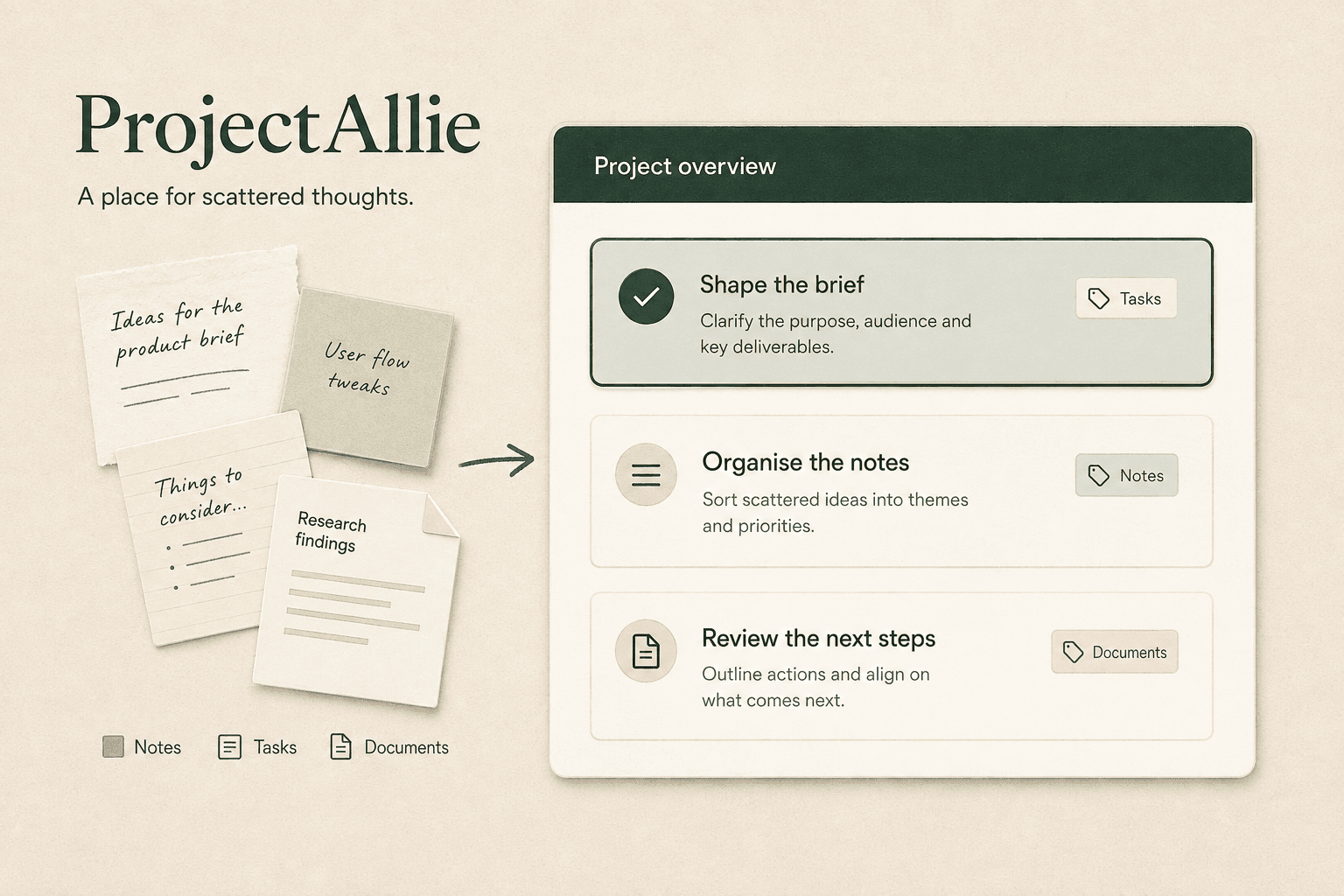
An assistant that turned scattered notes into structured projects, with retrieval over the user's own documents
- ROLE
- Sole developer
- STACK
- Next.js · React · PostgreSQL · Prisma · OpenAI · Node
- LINK
- ARCHIVED
BRIEF
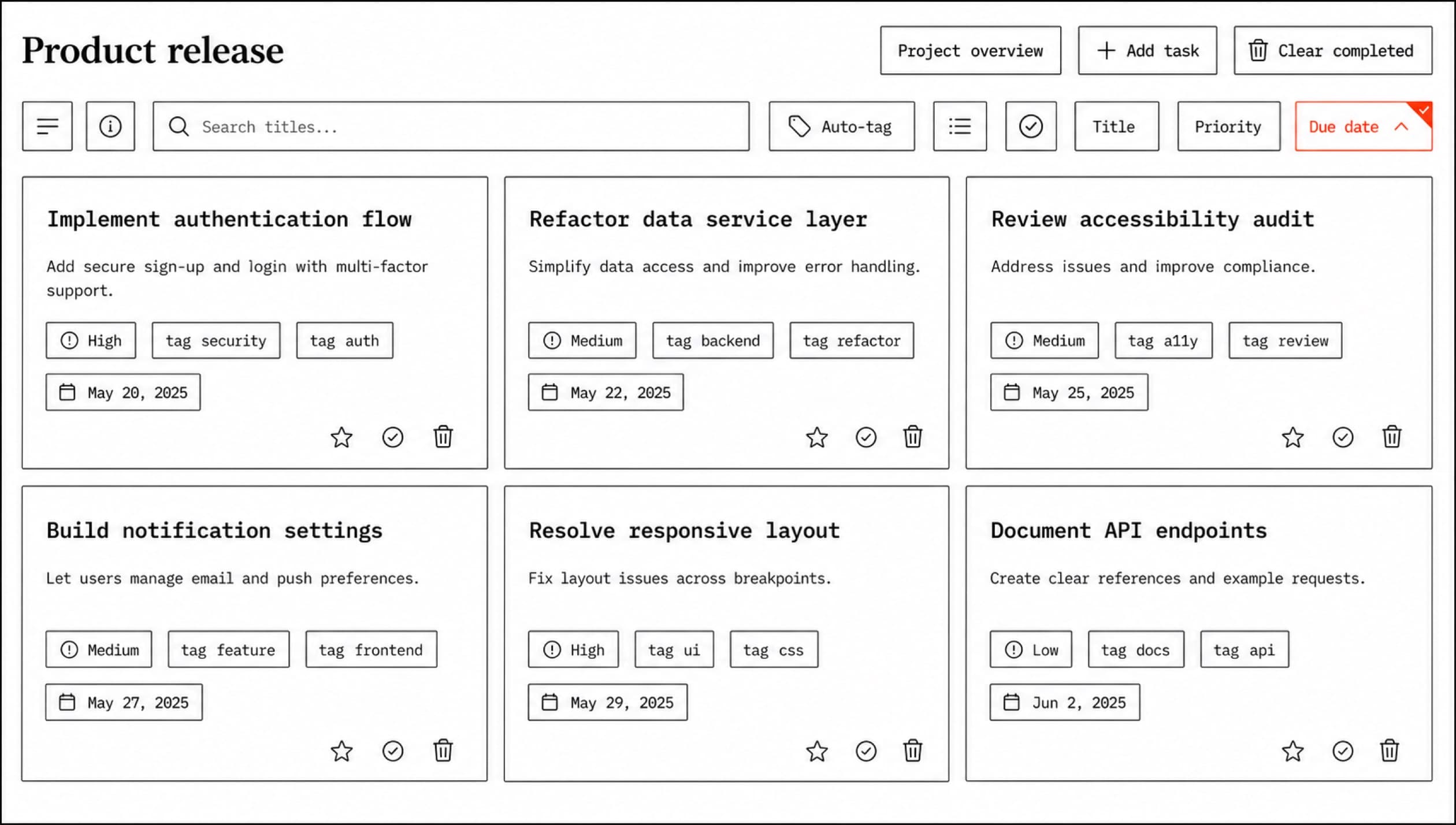
An assistant that turned scattered notes, emails and documents into structured projects, broke large pieces of work into smaller ones, and searched the user's own files to answer questions about them. It was for people whose work was too involved for a notes app and not large enough for project software. It shipped, ran, and has since been retired.
Destructive actions stay manual
The assistant could create, organise and restructure freely. It could not delete a task or a note.
That line was drawn because of what happened in testing: given latitude, the agent would occasionally make a judgment call that lost information. Not often, and not unreasonably, but an assistant that is usually right about what to discard is still an assistant that discards things you needed. The fix was structural rather than a better prompt. Removing the capability removes the failure mode.
Focused agents, pre-emptively
Narrow, focused agents with tightly scoped instructions and tools, applied from the start rather than in response to a failure.
Two reasons. Reliability improves when an agent carries less, and a small model with well-optimised instructions and tools is materially faster than a large one, if you can get it to work. That last clause is the whole bet: the optimisation cost is paid up front, against a speed gain you only collect if the smaller model holds.
Built retrieval, then deleted it
Document search began as a chunking pipeline of my own against a Pinecone vector database. When OpenAI's API grew to offer embeddings and file search directly, the embeddings and the search moved across and the pipeline was removed.
Deleting working infrastructure because the platform absorbed it is the correct call and an uncomfortable one. The code was fine; it had simply stopped being the best answer to the question.
CONSTRAINT
It was built alone, and maintained alongside full-time work.
Built on a managed abstraction, and it was withdrawn
Orchestration ran on the OpenAI Assistants API rather than on hand-rolled tool loops. The API was subsequently deprecated.
The counterpart to the decision above, and the reason both belong in the same log. Leaning on a platform is what let retrieval be deleted; leaning on a platform is also what left the orchestration layer standing on something that was withdrawn. Both projects that followed, AgenticWP and BuyBye, orchestrate their own agents. That is not a coincidence and it is not dogma either; it is the price of the lesson being paid once.
NEXT PROJECT
Prince of Whales
A grounded conversational assistant constrained to regulated wording, handing guests through to a booking engine